
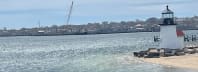
9.1.2 Chad's Big Trip
The Girl Who Ran the Polpis Road


(The Girl Who Ran the Polpis Road is a Henry Coffin novel. We are nearing the end and are in the final section, Endgame)
(If you want to start at the beginning, go here.)
(I am publishing another Henry Coffin story on Barr’d For Life. Her Father Came Home to Deacon’s Way is shorter, and also takes place on Henry Coffin’s Nantucket.)
On the last Wednesday in May, Simon was driving his son to LaGuardia. The traffic was heavy, Harrison had his earphones in, and the air conditioner was humming at high speed. Laura and the girls were finishing their packing for the summer, so they stayed home. More likely, this was a piece of parental penance both son and father had to pay.
With an hour, or more, to go in traffic, Simon wasn’t ready to spend it locked in an adolescent spit fight. Those moments will come.
Instead, he kept looking over the side of the boat to the sharks in the water. The Fidelity agreement looked attractive; they were going to put him in their big yard, put a collar around his neck, and let him play. It was retirement by another name. He couldn’t really sit at the big table anymore; it was no longer his table.
And, really, it had always been Athena’s.
On the other hand, he could cut out on his own and starve. The big clients would withdraw, then the staff would leave, and he would be squiring around some family money and a few old friends who send him something for old times’ sake. He was looking at afternoons at the golf course, stories at the bar, and investment seminars in the airport.
No.
There was a fin back there, as well.
The cleaners. The squad.
He couldn’t be sure. It seemed just a little too melodramatic.
He had almost convinced himself that he wasn’t a target. At this stage, what could they do? Tell tales on a dead woman? No, the target was Manville. Nothing good comes from targeting either Frances or himself.
And the money was gone.
That made the Fidelity choice much more simple. If there was close to 100 million sitting in the Toledo account, it would be more tempting to go out on his own. He had looked over all the work his staff had done. He had salesmen, he had managers, he had lawyers, and there were, if you squinted, one or two analysts who might have the potential.
But that money was gone. Athena, who hadn’t trusted him in the end, had done her dispersal of all of the funds. She had told him she would. That had been the goal, to use the money to do some good in the world.
Simon had money and he would have more. He had “generational wealth” for four children, four colleges, four graduate schools, and three weddings. He had a lot of life insurance. He could step back into the second or third flight of the grand tournament.
But there was still a fin back there, following him into the harbor.

“Harrison, take your headphones off.”
He didn’t look up.
“Harrison.”
Nothing.
“Harrison!”
“What?” He took one earbud out.
“We are twenty minutes out.”
“Good,” He moved to put the earbud back in.
“Do you know why you are going to Alaska?”
“Because I got caught with Cuervo in my dorm room?”
“Partially.”
“Because I got arrested outside the Chicken Box?”
“Also.”
“Because I am lucky and have privilege?”
“Also true.”
“And you would love to go to Alaska, paddle in a kayak, and shit in bushes.”
“Absolutely true. And there is one more reason.”
“What.”
“Now you are going to be six time zones away from your parents and hundreds of miles from an airport. There is nothing your mother, myself, or my checkbook can do to interfere with you. You get to be with you.”
“Great.”
“Sooner or later, you have to look in the mirror and like what you see.”
“Do you think this is about self-esteem?”
“No, I think it is about survival.”
“You’re just happy to be rid of me.”
“Well, I want to see the man you can become without me. Sometime soon, I will be dead.”
Harrison rolled his eyes.
Simon reached into his shirt pocket and handed Henry his phone back. “Here’s your phone. You left it in the parking lot at Surfside.”
He looked at it, turned it on, then switched it off. “You’re an asshole.”
“You have a strange way to pronounce ‘ thank you.’”
“I could have had this all week.”
“And you didn’t.”
He opened it.
“What did you do?”
“I took the nanny app off. We can’t track you anymore.”
“I don’t believe you.”
“Suit yourself.”
“Why did you put Venmo on this?”
“So we can send you money. Your cards don’t work.”
“You are an asshole.”
“I didn’t get to spend a night in jail.”
“Go fuck yourself.”
The two of them were silent for the rest of the drive. When Simon pulled up at the terminal, Henry opened the door before the car stopped. He went around back, opened the rear, pulled out his new pack and duffle, then left for the terminal.
Simon opened his door, closed the rear, and got back in. \
He had hoped for a better goodbye.
As he drove back to Connecticut, it occurred to him that he may never see Harrison again. There were, after all, sharks in the water.
On Saturday, before the christening, Pidge lay in bed.
Little Jim had just fed, and he was asleep. She had taken him off her breast and laid him on the sheets. He did not wake up, but his fingers splayed out as if he was trying to regrip her flesh.
Gabby sat in the room with the two of them.
“It must hurt.”
“It hurts worse if he doesn’t feed. Then, the milk comes in and it just builds like a water balloon. That hurts.”
“Christ.”
“It’s okay. At this point, everything hurts. You’ll see.”
“Maybe not.”
“I don’t think I know anyone who wants a baby more than you do.”
“Maybe I’ll get a surrogate.”
“No, I know you. You want to beat me at suffering. You want to be the best martyr.”
“I’ll let you know if I am going to take your Mommy Martyr Medal. Right now, show me your scar.”
With all of the complications about being a geriatric mother, everyone had agreed on a Caesarean section. It hadn’t been the blessing she had thought it was.
Pidge moved the sheets down and raised her nightgown up.
“The first thing Mommies have to sacrifice is modesty.”
“I see that.”
The scar was still covered in a bandage. Gabby very gingerly pulled it off. Pidge grit her teeth.
The scar was clean. No redness. No swelling. No pus.
“You look good.”
“You’re not the first one to say that.”
“I might be the first woman.”
“You keep believing that.”
Gabby started a new bandage.
“I bet they told you that could deliver the next one vaginally.”
“They said that.”
“The next one?”
“Look, I am not in charge anymore. That’s the biggest thing I learned. I don’t have anything to say. I am just a big dripping cow directed by hormones and pain. Things happen and I watch those things happen to me.”
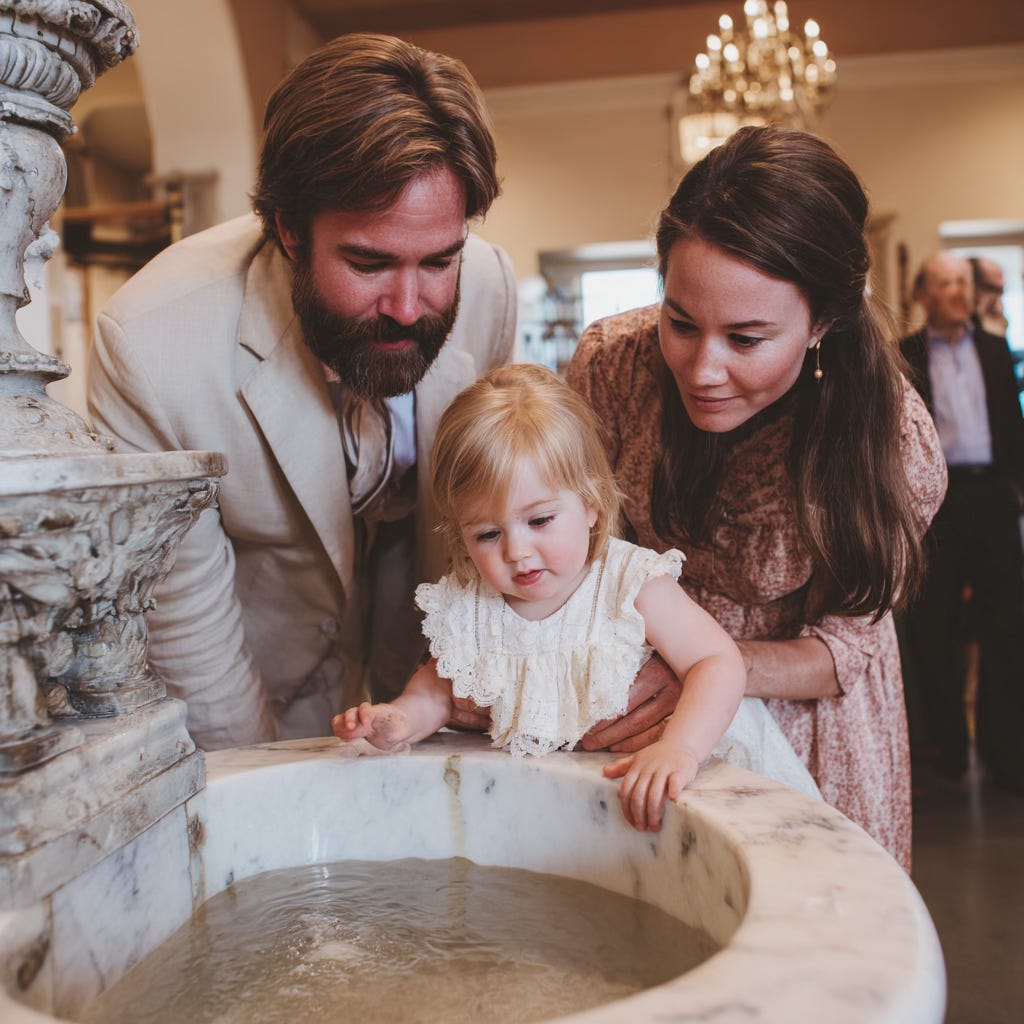
We love christenings.
Father Lopes either performs them privately in the church, with just the family and a wriggling little thing in a gown, or he does it during the Mass.
The family is exhausted. The mother is doing her best to look like she has it together, Dad is hoping nothing falls apart and the baby begins crying.
It’s adorable.
Pidge returned to the island and found that the monkeys were running the circus. She was drugged, sleep-deprived, sore, and brain fogged on Mommy hormones. All she wanted to do was lie in bed, sleep, and let the baby feed.
That’s it.
But Brian understood what was expected of him. He was the Man in Full, successful businessman, and pillar of the community. His wife had to get off the sofa, get dressed, pretend to be a good wife, and bring the parasite to the church.
Then she could lie down again.
Moira had become the indispensable leprechaun. She had stocked the baby’s room, found all of the little “mother’s helpers” gadgets and doodads that Instagram recommended, and brought out the crib.
As if Pidge was going to let her baby leave her bed.
The leprechaun worked with Wendy, Brian’s first wife. She, as a veteran of the Swains, Nantucket, and motherhood, knew what needed to be done and what Pidge could not do.
Like walk into the kitchen.
Or wash the other little girls’ clothes.
Or plan for a party after the Christening.
So, Pidge had sister wives. They promised to get out of her hair when they needed to, but Pidge knew better. She had entered the sisterhood when she married Brian. Now she owed them.
So when she saw that Moira, the indispensable leprechaun, was the new owner of Paul Brody’s big Bronco, she had herself a big old cry. A big one.
Some of my writing…
Barr’s For Life: A substack of essays and claptrap
The Boat at the End of Lover’s Lane
The Inn on Brant Point (Novella)
Her Lover on Monomoy Road. (Novella)
Winter: A Collection of Island Living Essays set between January and April 1.
Spring: The next collection of Island Living Essays set in April and May
June, Essays about Nantucket in June.
July Essays about Nantucket in July
August: Essays about Nantucket in August
Autumn: Essays about Nantucket in Autumn.
The Boys: A collection of essays about my two sons, written as they grew.
Rolling in the Surf: Essays on Teaching.

Barr’d for Life is a reader-supported publication. To receive new posts and support my work, consider becoming a free or paid subscriber.